Rethinking symbolism.
After isolation made me an artist, I’ve been creating more artwork every day than just my daily isolation folder. One day, I was reminiscing about the many holidays I spent at my aunt’s home in Jerusalem, which was filled with her ever-growing collection of pomegranate-inspired objet d’art.
I contrasted that to now, thinking back to how I had a solitary Passover seder this year for the first time in my life. I thought “I’m going to paint a pomegranate.”
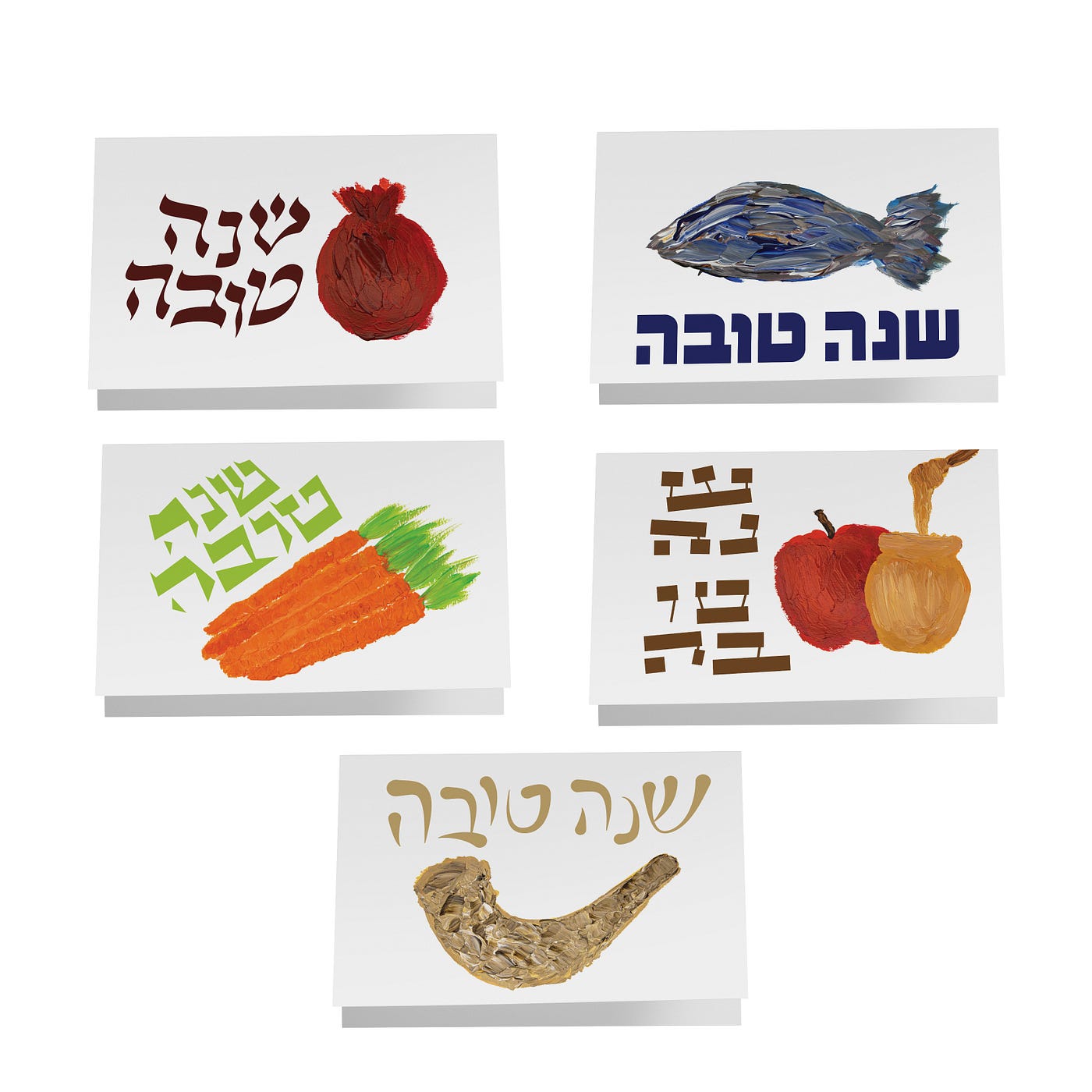
That led me down the rabbit hole of painting some more Rosh Hashanah-related symbolic items, and a collaboration with the brilliant artist and typographer Hillel Smith to create a collection of Shana Tova (“Happy New Year”) cards, traditionally sent before the holiday.
As I was chatting with Hillel, I said “I painted a pomegranate, an apple & honey, a fish, a shofar, and carrots.” “Ezra, no one is going to understand the carrots.” “Come on, it’s symbolic, it’s a play on words (the word for carrot sounds like the word for ‘decree’ in Hebrew), it’s 2020 and we need all the evil decrees and machinations stopped.”
So we are releasing a set of five cards, with Hillel’s fun and whimsical Hebrew typography matching each of my painted symbols. And I agreed to write explanations for each of the cards. So I began by writing all the traditional reasons these various things are symbolic at this time of the year.
Buy the Shana Tova Collaboration Greeting Card set
And then things took a dark turn. It became something that was no longer “marketing copy”. I thought again about symbolism.
I’m obsessed with semiotics, which is the study of symbols and signs. How we convey our identity by how we dress, talk, and eat. How the market irrationally moves because of a misunderstood signal or an errant tweet. How something isn’t a dog whistle if everyone can hear it.
I don’t believe that the practice eating a specific food at the beginning of the year to be symbolic for that year is superstitious, even though when witches do it, it is. I think it’s more about telegraphing intentionality. When we say something aloud, we make it real. Research shows that when you actively announce that you are going to do something, you are more likely to actually follow through with it.
There is an aspect of telegraphing intentionality in semiotics, a la “dress for the job you want”, “clothes make the man”, and myriad other concepts that have nothing to do with clothing but that I can’t think of at this very moment.
Isolation has made me rethink my relationship with creativity, a topic I’ve researched for years. But being in the petri dish of my apartment, I feel like I have learned more about creativity in 5 months than in 15 years.
One test of creativity is looking at an object, and thinking about all the things you can do with it. (I once built a website called FourCoconuts that did exactly that. Every day it would ask a question like “what can you do with four coconuts?” and people would come up with the most fascinating ideas. A story for another day and another essay.)
What if we apply the same practice to symbolism? What else can these symbols represent?
The Jewish tradition is full with this sort of adaptive symbolic creativity.
Take the ubiquitous carrot, for example. One of the vegetables the Yiddish speaking Jews of Eastern Europe had access to were carrots, so they created a different wordplay for carrots to act as a symbol for “more good deeds”, because the word in Yiddish was “mehren” and “mehr” means more.
Or the humble beet, the central ingredient in a delicious borscht, any time of year, warm or cold. It was a common, accessible vegetable, so they came up with some other wordplay. The word in Hebrew is “selek”, which sounds like the verb “to remove”. Therefore, on Rosh Hashanah, you symbolically eat beets in order to remove your enemies.
I’m assuming that if there were a larger Jewish community in the Philippines, there would be a Rosh Hashanah tradition surrounding the durian fruit. Or in Colombia, the guanabana (for a delicious year).
Symbols instigate dialogue. When you wear a t-shirt with a band name, other fans will approach you and ask about your favorite album. (Unless you are wearing a t-shirt from Better Than Ezra, and it just says “Ezra”.)
If all the symbols at the Passover seder force us to discuss the concepts of freedom and slavery, maybe the symbols on Rosh Hashanah should include the fact that it’s considered to be the new year for all beings on earth.
Yes, apples and honey represent a sweet new year. Apples and honey also represent a phenomenon that many of us are blissfully unaware about. Bees are dying off. Over the past few decades, colony collapse disorder has happened when the majority worker bees left the honey bee colony they were a part of, leaving the queen and immature bees behind, unable to fend for themselves. Without the pollination of bees, most of our food doesn’t grow. Pollination services have become a huge business.
I attended a charity dinner a few years back, in which the chef designed an entire menu on things that require pollination to grow. It takes an ecosystem, and when one of the parts disappears or doesn’t work, everything comes to a halt. If you need another example, google “‘supply chains milk covid”. Or just read this.
As I write on the site, “[f]ish have long been used as a symbol of a hyper fertile and progenitive species. Besides the obvious biological aspect of the procreation, another reason is because we can’t accurately count all the fish in the sea, there are way too many!” (For another fish-related symbol, ask your Latin speaking Christian friends.)
But what if we just think about fish in the world today, not as a symbolic concept, but as a reality. Does the symbolism still stand? Fish kill is a real problem. Between the warming of the oceans, pollution, and non-sustainable fishing practices, many fish populations are dying off. According to research reported in 2006, it turns out that fish are having fewer eggswhen the larger fish are killed off. Before we wax poetic about a lofty idea, let us make sure that the circumstances haven’t changed. And if they have, we must ask what we can do about it.
Pomegranates and carrots are healthy and colorful. They each have their own symbolism, we eat pomegranates so “that our merits should be as many as the seeds of the pomegranate”, and I’ve explained various versions of carrot wordplay above.
Pomegranates and carrots are also symbolic of greed. The largest producer of pomegranate juice in the United States also happened to be one of the largest consumers of water, during the California drought. Carrot prices in the UK were kept artificially low, meaning that it takes more work for growers and packers to make less money. In cases of calamity, the farmers lose out.
Should our trendy affordable juicing trends be built on the backs of immigrants working in the hot sun for pitiful wages?
All four of these items show the need for increased cooperation between us as individuals, as members of communities, as citizens of countries and the world. We are responsible for our neighbor, that’s why we wear masks. That’s why we pay working wages. That’s why we want them to have the freedoms and comforts that we ourselves do. We must share in the natural resources that we have available to us, and conserve them when we can.
Sometimes we don’t need esoteric symbolism, the thing itself can tell its own story. And let’s use this opportunity to start the conversation.
Shana tova!